#57 Rock Delivery
The workhorse drainage stone of South Florida. Open-graded, angular, and the default answer whenever water has to move through rock instead of sitting on it.
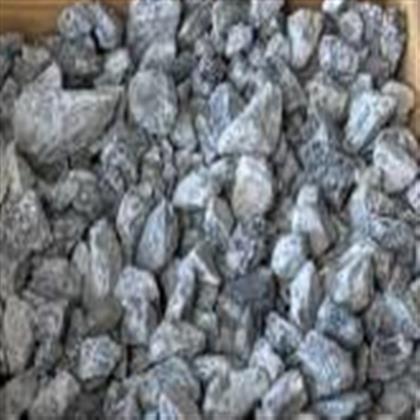
What #57 rock actually is
#57 is a gradation, not a rock type. The number comes from the AASHTO/ASTM sizing chart, and it describes stone that passes a 1-1/2 inch sieve and is retained on a No. 4 — in practice, pieces running roughly three-quarters of an inch to an inch, with the fines washed out.
In most of the country #57 is granite or trap rock. In South Florida it is crushed limestone, quarried locally, which is why it costs a fraction of what the same gradation costs in Georgia and why nearly every drainage detail on a Broward or Miami-Dade plan set specifies it. You will hear it called #57 stone by engineers and spec writers and 57 rock by everyone actually standing on the job. Same material.
The defining property is what has been removed. Because the fines are washed out, the stone will not knit together and will not compact. Stack it and it stays a pile of loose angular rock with roughly a third of its volume as open void. That void is the whole point: water runs straight through it instead of perching on top.
What contractors use it for
The dominant use in our delivery area is drainage. A French drain is a trench, a perforated pipe, filter fabric and #57 rock — and given the water table across most of Broward and coastal Miami-Dade, that detail shows up on a very large share of the residential and light-commercial work we haul for.
The second big use is beneath concrete. A washed-stone layer under a slab gives water somewhere to go and gives the vapour barrier a clean, stable bed to sit on. Three to four inches is typical unless the engineer calls for more.
It is also the standard coarse aggregate in ready-mix concrete, which is why the plants buy it by the barge-load, and it makes a serviceable loose driveway — though be honest with yourself about that. Angular #57 walks under tyres and migrates toward the edges. If you want a driveway that stays put, limerock base or crushed concrete compacts into something you can actually drive on for years. #57 is for when drainage matters more than a firm surface.
Getting the quantity right
#57 is sold and delivered by the ton. Plans are usually drawn in cubic yards. The conversion in South Florida runs about 1.35 tons per cubic yard — call it 2,700 pounds — though it varies a little pit to pit depending on how dense the parent limestone is.
The arithmetic most people actually need: one ton of #57 covers roughly 110 square feet at 2 inches deep, or about 55 square feet at 4 inches. A standard tri-axle brings 22 tons, which is enough to put 4 inches across roughly 1,200 square feet.
For trench work, multiply length × width × depth in feet, divide by 27 to get cubic yards, then multiply by 1.35. A 100-foot French drain at 2 feet deep and 1 foot wide is 200 cubic feet, which is 7.4 cubic yards, which is about 10 tons. Our tonnage calculator does this for you and tells you how many loads it works out to.
Order a little heavy. Running short by two tons on a Friday afternoon costs you a whole extra delivery and a crew standing around; two extra tons in a pile costs you almost nothing and gets used somewhere.
Ordering and delivery
Minimum delivery is one cubic yard, so a short French drain is as welcome an order as a warehouse pad. A standard tri-axle carries about 22 tons — roughly 16 cubic yards — and a quad up to 24 tons. Price per yard improves as the quantity rises, so if you are close to a full load it is usually worth rounding up.
Same-day is realistic on #57 if you call before 11 AM and the pit has it staged, which it usually does — this is the highest-turnover stone in the region. Next-day is the norm. For anything over 50 loads, give us 48 to 72 hours so we can stage trucks and lock pricing.
Tell us about site access when you order, not when the driver arrives. Overhead wires, soft ground, gate widths, HOA delivery windows and where exactly you want the pile dropped all change which truck we send. A tri-axle needs room to raise a bed roughly 25 feet in the air and firm ground under the rear axles.
What it costs, delivered
Specification
| Property | Detail |
|---|---|
| Gradation | AASHTO / ASTM No. 57 — passes 1-1/2", retained on No. 4 sieve |
| Material | Crushed limestone (South Florida oolite or Ocala formation) |
| Shape | Angular, crushed faces |
| Washed | Yes — minimal fines |
| Drainage | Free-draining; roughly 30–40% void space |
| Compaction | Does not compact — consolidates only, no proctor spec |
| Approx. weight | 1.35 tons per cubic yard (2,700 lb) |
| Coverage at 2" | ~110 sq ft per ton |
| Coverage at 4" | ~55 sq ft per ton |
Figures are typical, not guaranteed. Weights and gradations vary between pits and sources. If your job is specified, send us the relevant plan sheet and we will match it — and confirm quantities against your own scale tickets once you are running.
What it is used for
- French drains and trench drains — the standard backfill stone
- Septic drainfields and pump chambers
- Under-slab drainage layer beneath concrete
- Pipe bedding and backfill where flow matters more than support
- Coarse aggregate in ready-mix concrete
- Loose driveways and equipment pads where mud is the enemy
- Erosion control at downspouts and swale outfalls
Working out how much you need
Material is sold by the ton. Plans are drawn in cubic yards. That mismatch is where most ordering errors come from, and they are expensive in both directions — running short stops a crew, and over-ordering by a large margin ties up money in a pile.
The arithmetic: multiply length by width by depth in feet, divide by 27 to get cubic yards, then multiply by the material's weight per yard. Most rock runs about 1.35 to 1.4 tons per cubic yard; compacted base is heavier at roughly 1.65; topsoil is lighter at about 1.15.
Then allow for compaction. Base and fill lose roughly 20 to 25 percent of their loose volume once they are properly compacted, so the tonnage you order should be above the theoretical plan volume. Our tonnage calculator builds that allowance in and converts the answer into truckloads.
Order slightly heavy. Two extra tons in a pile costs almost nothing and always gets used. Two tons short on a Friday afternoon costs you a whole extra delivery and a crew standing around.
#57 Rock — common questions
Is #57 stone the same as #57 rock?
Will #57 compact for a driveway base?
How many tons of #57 are in a truckload?
Can #57 be used under pavers?
Where we deliver #57 Rock
Both coasts. Palm Beach, Broward and Miami-Dade down through the Keys, and Manatee, Sarasota, Charlotte, Lee and Collier on the Gulf side. Mainland deliveries are same or next day; the Keys are scheduled runs.
Related materials
Stop Babysitting Your
Material Suppliers. Call Us.
A locked quote in under an hour. Trucks on site when you need them. One invoice when the job's done.